For Young Learners · Data Science Basics
📊

The 3 V's of Big Data

Understand Volume, Velocity & Variety — the three ideas that define Big Data!

📦 Volume ⚡ Velocity 🎨 Variety ☁️ Cloud & AI
Section 1

What is Big Data? 🤔

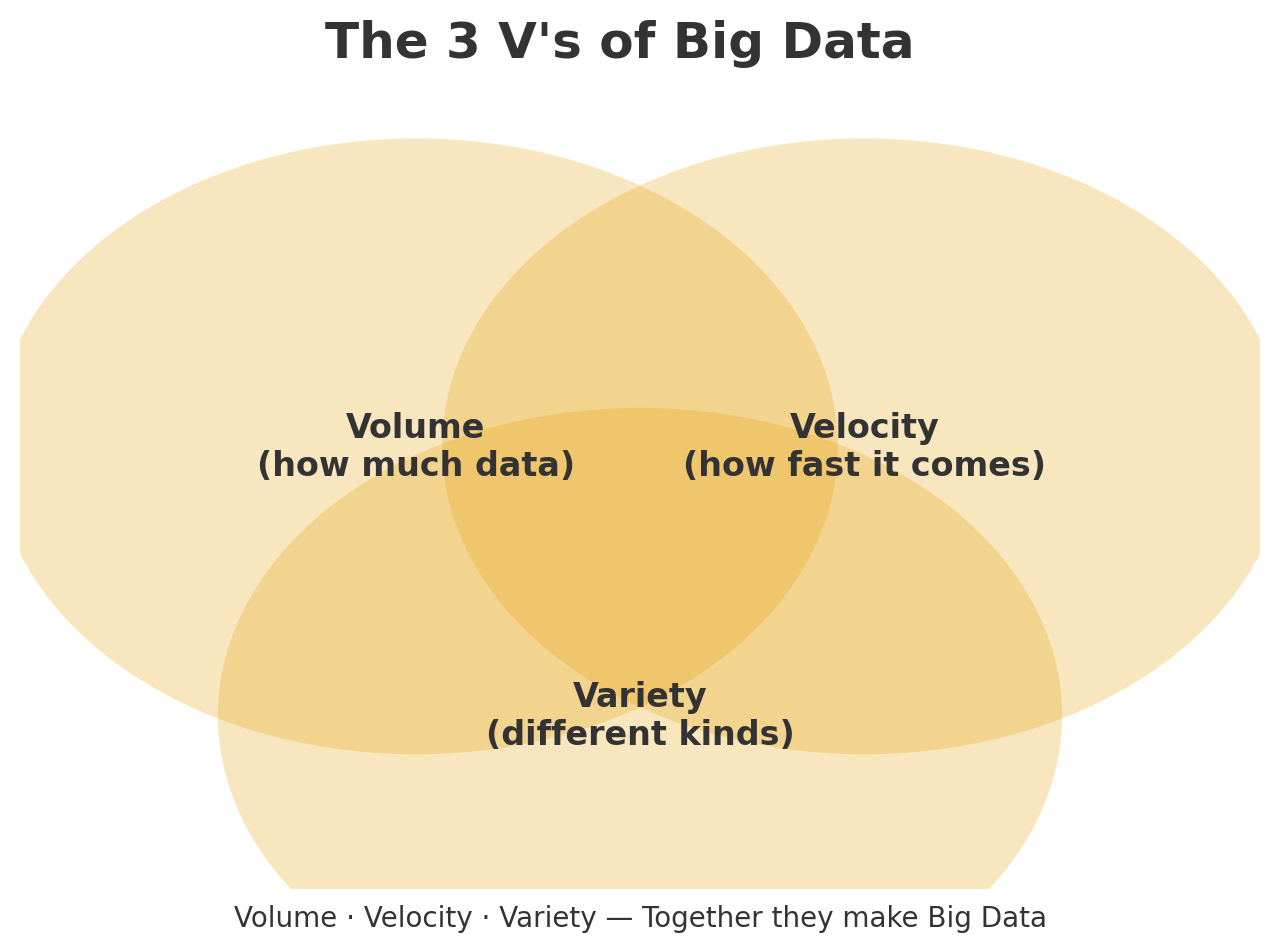
3 Vs of Big Data – Venn diagram showing Volume, Velocity, and Variety overlapping

Volume · Velocity · Variety — Together they make Big Data

Big Data is data that is too large, too fast, or too varied for regular computers to handle. We describe it using the 3 V's: Volume, Velocity, and Variety. Special tools — like cloud systems, distributed computers, and AI — are needed to capture and make sense of it.

💡 Think of it like this: Big Data is like a super-fast, giant waterfall of different things all pouring in at once — you need special equipment just to catch it!
Section 2

The 3 V's Explained 🧱

📦

Volume

How much data

Enormous amounts of data are created every second — think of every photo uploaded, every message sent, and every search made. That's Volume!

Velocity

How fast it arrives

Data streams in real time — social media posts, live sensor readings, stock prices changing every millisecond. Speed matters as much as size!

🎨

Variety

Different kinds of data

Data comes in many forms: text, images, videos, audio, GPS locations, sensor numbers, and more. Handling all these types together is the challenge!

Section 3

Key Ideas 💡

1

Volume — How Much

Every day, people create around 2.5 quintillion bytes of data. That's 2,500,000,000,000,000,000 bytes! Regular computers can't store or process this — you need huge data centres with thousands of machines working together.

Like: filling an Olympic swimming pool every second 🏊
2

Velocity — How Fast

Twitter sees hundreds of thousands of tweets per minute. Weather sensors update every few seconds. Financial markets process millions of transactions per second. Data doesn't wait — systems must handle it instantly.

Like: catching raindrops one by one in a storm 🌧️
3

Variety — How Different

Structured data (neat rows and columns), unstructured data (emails, videos, images), and semi-structured data (JSON, XML) all arrive together. Making sense of such mixed data requires clever tools like AI and machine learning.

Like: sorting a giant mixed bag of puzzle pieces from different sets 🧩
4

Why Regular Computers Struggle

A normal computer has limited storage and RAM, and processes tasks one by one. Big Data needs distributed computing — spreading work across thousands of computers at once — and special frameworks like Hadoop and Spark.

Like: one person vs a whole army of helpers 🪖🪖🪖
5

Big Data in Real Life

Netflix recommends films using your watch history (Volume + Variety). Hospitals track patient data in real time during surgery (Velocity). Weather apps analyse millions of sensor readings worldwide (all 3 V's together!).

Like: a super-smart assistant who never forgets anything 🤖
Section 4

Short Activities ✏️

1

Give one example of Volume, one of Velocity, and one of Variety from your daily life.

2

Why do you think regular computers struggle with Big Data? Write your thoughts below.

3

Draw or write a small example of Big Data — for example: all phone photos ever taken, live sports streaming data, or lots of weather sensor readings from around the world.

🎓 Remember: Big Data is everywhere! Every app you use, every search you make, and every photo you take is part of the Big Data world.